
What "Participial-Tail" Means, and Why It's Probably in Your Last Paragraph
Nine words keep showing up right after a comma in AI prose, restating what the sentence already said. Here's why it's so hard to self-edit out.
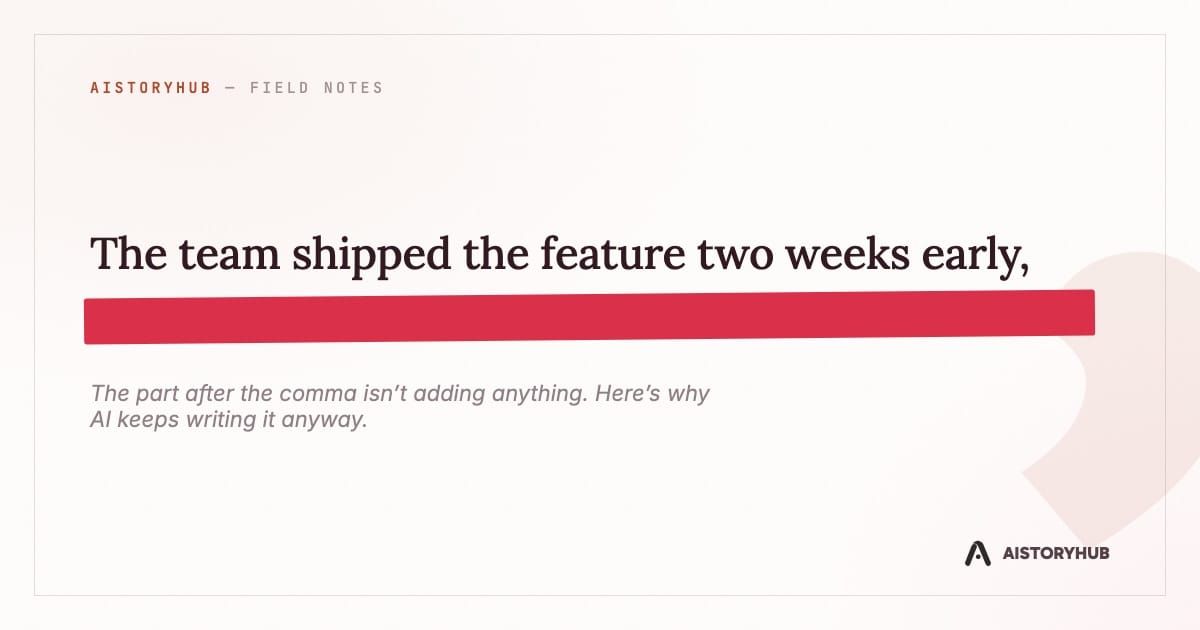
We added a rule to our AI-writing detector two weeks ago that catches nine words: underscoring, highlighting, emphasizing, reinforcing, reflecting, signalling, showcasing, illustrating, demonstrating. Specifically, it catches those nine words when they show up right after a comma, closing out a sentence that already said what it meant.
"The team shipped the feature two weeks early, underscoring their commitment to the deadline."
Read that sentence once. Now cover everything after the comma with your hand. "The team shipped the feature two weeks early." That's already a complete, true, specific sentence on its own. Uncover your hand and read the rest: "underscoring their commitment to the deadline." What did you learn? Nothing you didn't already know from the first six words. Shipping early is what it looks like to commit to a deadline. The tail isn't adding information. It's restating the sentence's own point back at you in a different grammatical shape, a lawyer summarizing an exhibit that's still sitting right there on the table.
We call this the participial tail. It's one entry in the corpus of AI-writing that we maintain for AIStoryHub's Slop Checker (758 entries as of today, and climbing), and it might be the hardest single one to self-edit out, because on a skim it reads as good writing. The rhythm is familiar, the shape of a hundred press releases and a thousand LinkedIn posts. It sounds finished.
Three more, in the wild
A cover letter: "I led the migration to the new billing system ahead of schedule, demonstrating my ability to manage complex technical projects under pressure." Cut after "schedule" and you've lost nothing. Leading a project in ahead of schedule already demonstrated the ability. The clause is the résumé equivalent of a car alarm going off after the car's already been stolen.
A blog post: "Adoption climbed 40% in the first quarter, reflecting growing confidence in the platform." The number is the evidence. The clause just tells you what conclusion you're supposed to draw from a number you could already read yourself.
Fiction, where this gets more interesting because the tell usually shows up wearing an emotion instead of a metric: "She closed the door quietly behind her, illustrating the care she still took not to wake him." A reader doesn't need "illustrating" to know that closing a door quietly is careful. The action already told them. The gerund clause is the narrator leaning into frame to explain the shot they just showed you.
We went looking for why this specific shape keeps turning up, and the likeliest answer is boring: these models are trained on an enormous amount of writing whose job is to be legible on a skim, marketing copy, press releases, case studies, the kind of prose written for an editor or an algorithm rather than a reader with time to spare. That genre rewards restating your point in two registers, once as a claim, once as a gloss, and somewhere in the training distribution that habit got rewarded as "clear" instead of flagged as redundant. It's probably not a coincidence that all nine verbs on our list are verbs of interpretation, not verbs of action. None of them do anything themselves; a door still has to get closed, and a feature still has to ship somewhere earlier in the sentence. Every one of them just narrates what already happened.
Where the rule almost went wrong
We almost shipped a version of this rule that flagged any comma followed by an "-ing" clause. We caught it in testing because it lit up half our own test corpus, including sentences like "he left the room, muttering to himself" and "she stood there, waiting." Those are ordinary English gerund clauses, doing what gerund clauses have always done: adding a second, simultaneous action. The failure mode wasn't the grammar. It was that we'd confused a construction with a symptom. So the rule got narrower. It only fires on that closed list of nine abstraction verbs, the ones whose entire job is to tell you what you were supposed to notice rather than show you something new.
If you want to check your own draft for this, you don't need our tool. Open the document, search for "-ing," and for every hit, cover everything before the comma and ask whether the sentence would lose a fact if you deleted the clause after it. Most of the time, especially if the word is underscoring, highlighting, emphasizing, reinforcing, reflecting, signalling, showcasing, illustrating, or demonstrating, the answer is no. Delete it. The sentence that's left is usually the better one. It was there the whole time, underneath the part that was explaining itself to you.