
Story Rules Just Learned Your Story
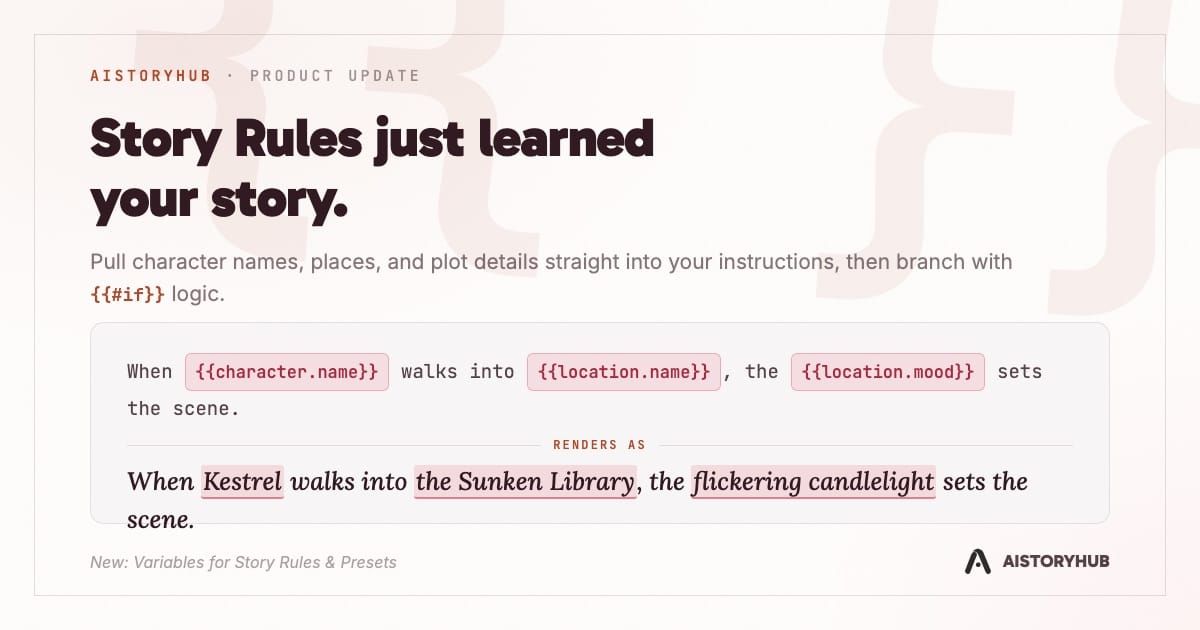
Story Rules and Presets can now reach directly into your story's own codex at the moment a chapter generates.
Every writer who has finished more than one book has, at some point, taped an index card to a wall. A character's eye color. The year the war ended. Which sibling died first. None of it matters to a reader in any single scene. But get one of those details wrong in chapter twenty-two after getting it right in chapter three, and something breaks that a reader can feel even when they can't name it.
Writers' rooms solved this decades ago with the show bible: a living document of who everyone is, what's already happened, what can't happen again. It works because someone updates it and everyone reads it before they write. Neither of those is guaranteed. A show bible is only as good as the last time anyone opened it.
Story Rules in AIStoryHub had the same weak point. You'd write an instruction once, something like "keep Mira's dialogue clipped and dry," and it would sit there as plain text, doing its job for as long as the story stayed roughly the shape it was when you wrote it. We built the first version this way ourselves, mostly because it was the obvious approach, and it held up fine for about ten chapters. Then the cast grew, Mira picked up a verbal tic nobody had planned, and the rule kept saying the same six words while the story underneath it kept changing. The instruction wasn't wrong. It just hadn't been told anything new since the day you wrote it.
The fix wasn't a bigger text box. It was giving the rule somewhere to look.
Story Rules and Presets can now reach directly into your story's own codex at the moment a chapter generates. Write "when {{character.name}} enters {{location.name}}, let the {{location.mood}} set the scene," and at generation time AIStoryHub resolves those against whatever is actually in your world bible right now, not whatever was true when you typed the rule. Add a location in month four, rename a character in month seven, and every rule that references them updates itself. You never touch the rule again.
Named lookups work the same way for anything you've already built out. {{locations.the sunken library}} pulls that location's own description, live, the way you'd expect a reference to work rather than an index you have to keep straight. Lookups match by name now, not by list position, after an earlier version kept a tidier index internally but broke silently the moment you reordered your world bible and a rule quietly started pointing at the wrong place.
The part that changes how a rule actually behaves, though, is the conditional. {{#if}} / {{else}} lets an instruction fire only when it's true. "If this scene is set in the tavern, mention the bartender's limp. Otherwise, don't." That's a different tool than a blanket style note. A blanket note either applies everywhere, which is usually wrong, or gets deleted the first time it doesn't fit, which throws away work you did on purpose. A conditional rule can carry a specific piece of continuity through an entire manuscript and only speak up in the scenes where it belongs.
One version of this let rules loop, repeating a note for every chapter or every character in a list. It worked, in the sense that it ran. It also turned a note to a co-writer into a small program, and the moment you're debugging your own writing advice, something has gone wrong with the tool, no matter how capable the engine underneath it is. We kept the branch and cut the loop. {{#if}} still reads like a sentence a person could say out loud. A while loop doesn't.
Story configuration variables close a smaller but real gap. {{story_config.banned_words}} pulls straight from whatever list you've already set for the story, so a rule that says "avoid these words" stays synced to one source instead of six copies of a list you update in only one of them. {{characters[0].dialogue_style}} pulls a character's established speech pattern into a rule instead of asking you to redescribe it, again, in every instruction that touches them.
None of this asks you to learn syntax for its own sake. The point was never the curly braces. The point is that the story bible writers have always kept beside them, on cards, in a binder, in a shared doc nobody reads often enough, is now something the AI actually consults, every single time it writes, without you having to remember to remind it. The rule doesn't get stale because it was never really static text to begin with. It was always a question, and now it gets asked, and answered, the moment it matters.