
Private Sharing Is Here
There's always a gap between what you can see and what the page actually says. The only way to close it is to hand the work to someone who isn't inside your head — but getting a draft to the right readers, without exposing it to everyone, has always been harder than it should be. Today that changes.
The draft you finish at 2am is not the draft anyone else reads. There's always a gap between what you can see and what the page actually says, and the only way to close it is to hand the work to someone who isn't inside your head.
That gap is why beta readers exist. And getting them the draft, without throwing it open to the whole internet, has always been an awkward dance: shared Google Docs with long permission threads, zipped Word files in email, privacy settings toggled on and off. We wanted to fix that.
Starting today, you can share any story with readers you choose, through private links and organized groups, without making it public.
Every story in your library can now generate a private share link: a short URL you control. You decide who gets it. The story doesn't appear in any search, any public list, or any feed. Someone with the link can read the draft; someone without it can't. When you're done with that round of feedback, you revoke it and start fresh.
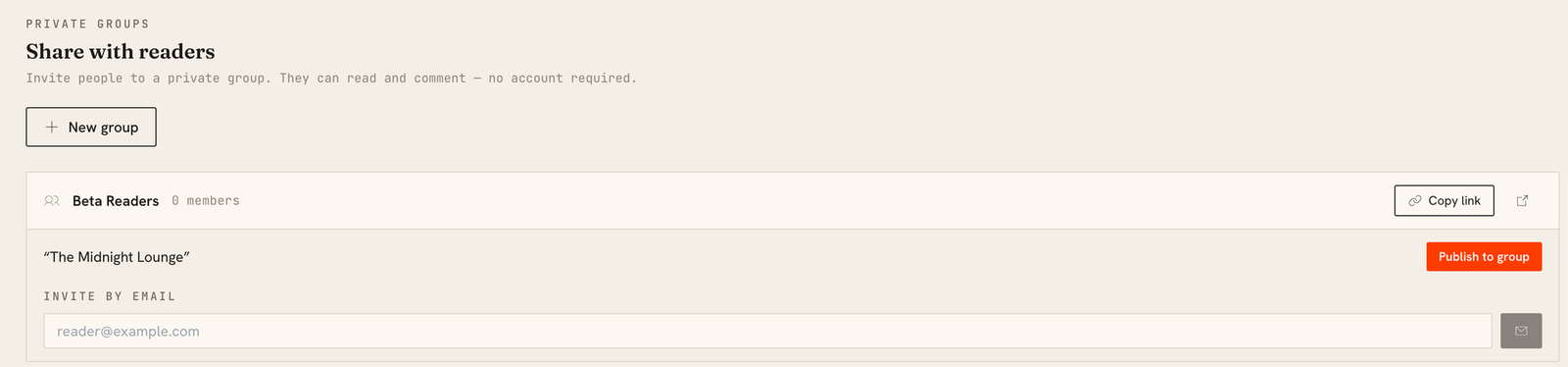
Groups take this further. If you're running a full beta-reader pass, you can create a group, name it whatever makes sense to you ("Draft 3 Readers," "Critique Circle"), and invite readers by email. Everyone you add lands in that group. From there you share chapters, drafts, or individual scenes to the group as a whole rather than link by link. When someone drops out or joins late, you manage it from one place.
The reason we built this in the order we did, links first and groups second, is that most early feedback doesn't come from a formed circle of trusted readers. It comes from one person, maybe two. Someone you met in a writing community, or someone whose taste you've come to trust. The single link solves that case right away. You don't need to set up a group to share a draft with a friend.
But some projects need more. I've watched writers manage a twelve-person beta read entirely by hand: spreadsheets tracking who got which chapter, multiple versions circulating at once, nobody sure which draft was current. The group feature is an attempt to take that organizational weight off your plate.
There's a version of this I got wrong early on, which was thinking the privacy control itself was the point. It isn't. The point is that private sharing lowers the cost of asking. When sharing a draft means potentially exposing it to anyone, you wait. You wait until it's cleaner, more finished, more ready. You wait until you've fixed the structural problem you already know is there, because you don't want the first impression to be of a broken book. That waiting kills the feedback loop that would have helped you fix it sooner. A private link, or a group, means you can send it at the stage when feedback actually changes what the book becomes, not the stage when it's more or less done.
To start: open any story, find the Share section, and either generate a link or create a group. The link copies with one click. The group prompts for an email address and sends an invitation. If you want to test it before inviting anyone else, open the link in a private browser window and you'll see exactly what your readers see.
One small thing: share links expire when you reset them, not on a timer. So you won't lose a link overnight while someone's still reading. When you're ready to close a round of feedback, you reset it manually.
The goal was to make this invisible enough that you stop thinking about it and get back to the work. We'll see if we got there.