Beyond Fiction: How to Use the Style Lab for Non-Fiction That Actually Grips
When most people hear "AI Story Hub," they (understandably) think "fiction." Novels. Short stories. Screenplays. But the platform's most powerful features are, in my opinion, secretly built for creating incredible non-fiction.

Let's start with a piece of text.
"You're staring at a wall of red.
Not metaphorical red. Actual crimson rectangles filling three monitors at 2:14 a.m., each one screaming a different flavor of catastrophe. Database connection pool exhausted. API gateway returning 503s. Customer-facing dashboard timing out. Your phone vibrates for the seventh time in three minutes. Slack pings drop down the right screen like a waterfall of panic.
Everyone's waiting for you to fix it."
Does that sound like a tech thriller?
It's actually the intro to a non-fiction post about technical leadership.
When most people hear "AI Story Hub," they (understandably) think "fiction." Novels. Short stories. Screenplays. However, the platform's most powerful features, in my opinion, are secretly built for creating incredible non-fiction.
The problem is that most AI-written non-fiction is... well, slop. It's dry. It's generic. It’s a list of bullet points wrapped in a "In today's fast-paced world..." intro. It has no voice, no authority, and no grip.
The best non-fiction, the kind that gets shared, that changes minds, that builds careers, is built on storytelling. And storytelling is exactly what AI Story Hub is for.
Here’s how to stop writing dry reports and start writing compelling, authoritative non-fiction using the Style Lab.
Step 1: Build Your "Expert" Voice in the Style Lab
Your first step is to stop using the default AI voice and build a custom persona. Your voice is your authority. For this example, I built a style I call "Systems Playbook Prose."
The goal was to create "an authoritative, second-person coaching style that fuses pragmatic step-by-step structure with strategic, systems-level insight... with an encouraging, mentor-like voice."
Here's the exact Style Lab formula:
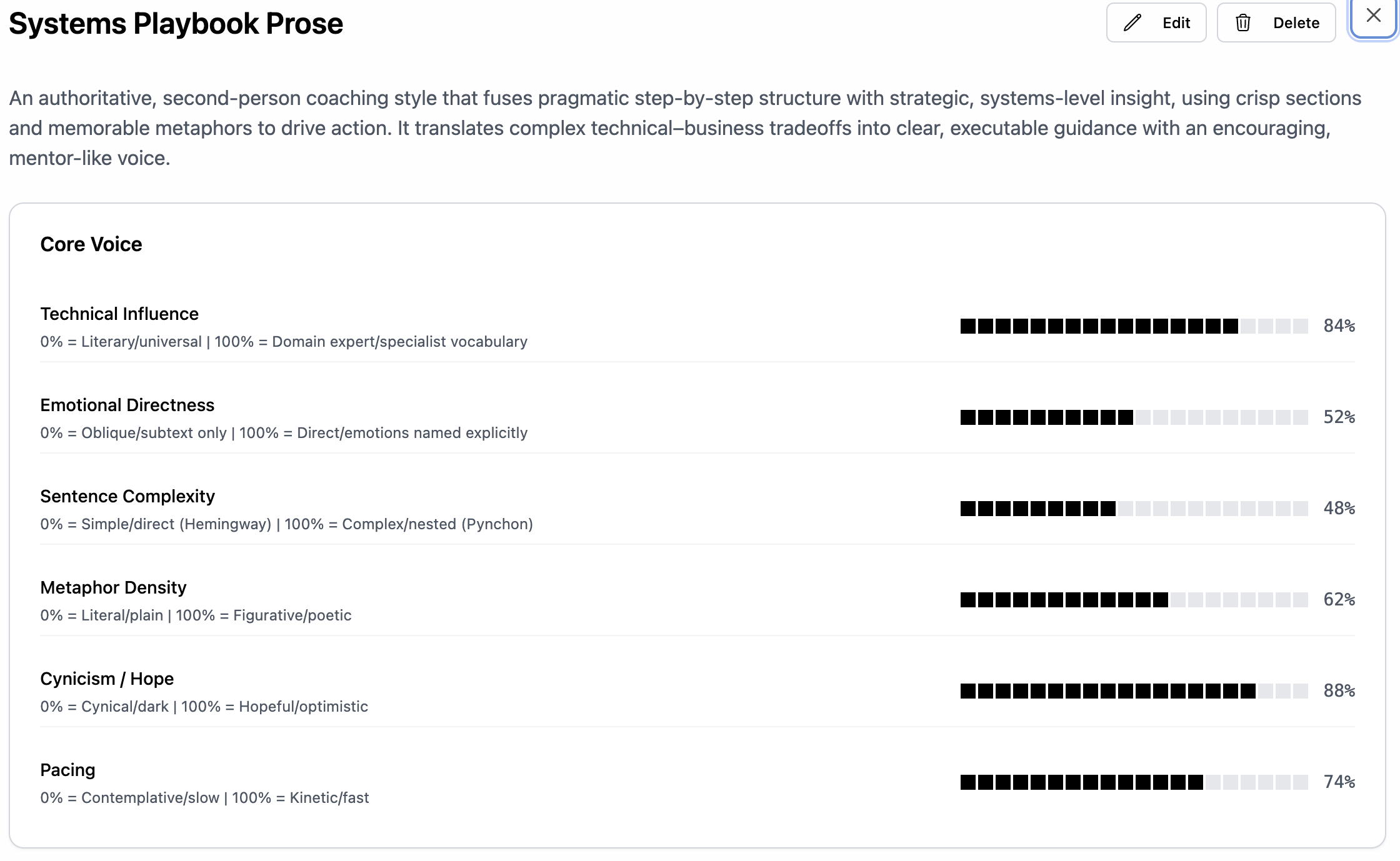
It may appear complex, but only a few key levers account for 90% of the work.
- Core Voice -> Technical Influence: 84% This is the most important setting. At 0%, the AI is a "Literary" writer. At 100%, it's a "Domain Expert." By setting this to 84%, I'm telling the AI: "You are a specialist. Use specialist vocabulary. Speak with authority. You are not a creative writing major; you are a senior engineer."
- Core Voice -> Cynicism / Hope: 88% This is the "mentor-like voice" part. Non-fiction, especially coaching or self-help, must be hopeful. A low score here creates a cynical, dark, or critical voice (great for noir fiction, terrible for a leadership guide).
- Core Voice -> Pacing: 74% We're setting this to "Kinetic/fast." Dry non-fiction is slow and contemplative. Compelling non-fiction has energy. It needs to move. This setting forces shorter sentences, more active verbs, and a feeling of forward momentum.
- Core Voice -> Metaphor Density: 62% This is the "memorable metaphors" part. We're not at 100% (which would be overly poetic), but we're way above 0% (purely literal). This gives the AI permission to use the "waterfall of panic" and "wall of red" metaphors that make the intro stick.
By simply adjusting these few settings, you've created an expert, encouraging, and fast-paced voice that is ideal for business, tech, or self-help writing.
Step 2: Use "Story" Structure (Even for an Article)
Now that you have your voice, you need a structure. And it turns out, the best structure for a non-fiction article is a story structure.
In Chapter Scaffolding. It's designed for fiction, but it's the perfect tool for outlining a non-fiction blog post.
Look at how the "wall of red" scenario maps to a classic story scaffold:
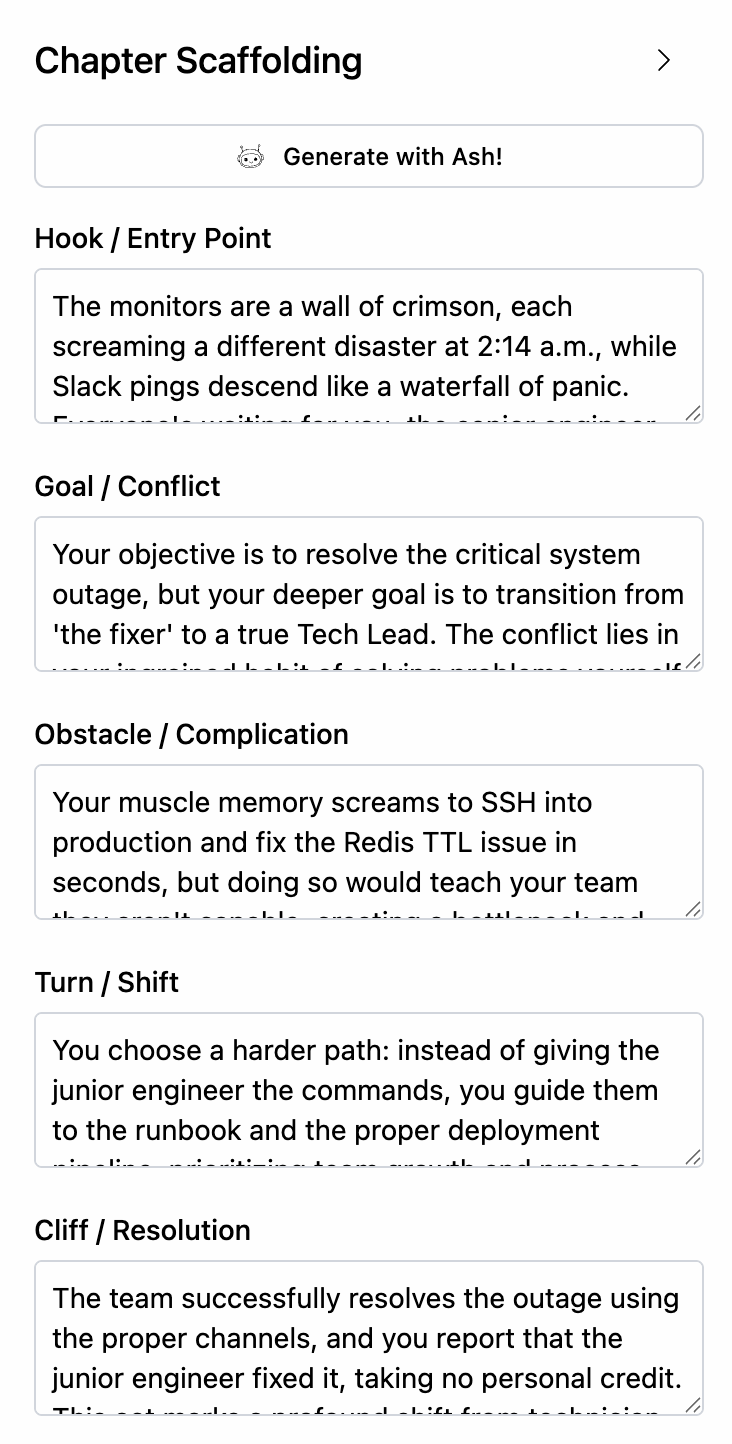
- Hook / Entry Point: "The monitors are a wall of crimson... Everyone's waiting for you." This is the pain point. It hooks the reader immediately.
- Goal / Conflict: "Your objective is to resolve the critical system outage, but your deeper goal is to transition from 'the fixer' to a true Tech Lead." This is the thesis of the article.
- Obstacle / Complication: "Your muscle memory screams to SSH into production... but doing so would teach your team nothing." This is the problem the reader faces.
- Turn / Shift: "You choose a harder path: instead of giving the junior engineer the commands, you guide them to the runbook..." This is the new idea or the "aha" moment you are teaching.
- Cliff / Resolution: "The team successfully resolves the outage... This act marks a profound shift from technician to leader." This is the actionable takeaway or the desired outcome.
Stop Writing Blog Posts. Start Telling Stories.
When you combine an authoritative Style Lab voice with a proven narrative structure, your "blog post" is no longer a dry report. It's a compelling story that grabs the reader, presents a problem, and guides them to a solution.
AI Story Hub isn't just for fiction. It's a platform for anyone who wants to write with a powerful, human, and memorable voice.
So, stop writing generic non-fiction. Build your own expert style in the Writing Style Lab and tell a story your readers won't forget.